Your own ordering website or an aggregator: what pays off for a café
What an aggregator’s commission really costs, when your own website pays for itself and how to run both channels without losing new guests.
Vitrina team5 minute read
Contents
In short
An aggregator brings new guests, but takes a cut of every order and keeps the guest’s data for itself.
Platforms that publish their terms take around 30% when their couriers deliver, and 13-14% when the venue delivers.
Your own website pays off fastest where there is a lot of pickup and regular guests.
A hybrid works best: the aggregator for new guests, your own website for regulars.
An aggregator sells guests, not delivery
Glovo, Wolt or Bolt Food bring people to your menu who had never heard of you. In return the platform takes a percentage of every order and keeps the guest: the platform, not you, sees their phone number, order history and bonus points.
For a new venue this is a fair trade: advertising paid for out of sales. The problem starts when your regulars order through the aggregator too, and every month you pay commission on people who already know you.
How much the aggregator takes
Glovo and Bolt Food don’t publish their rates; the exact percentage is only in your contract. Platforms that do publish their terms take around 30% when their own couriers deliver:
30%
Uber Eats commission in Poland when Uber couriers deliver; 14% when the venue delivers itself
Source: Uber Eats pricing
30%
is “the full standard” for Wolt in Slovakia and Czechia, according to Wolt’s director in a 2021 interview
Source: Denník N
30-31%
Lieferando in Germany with the platform’s courier; 13-14% when the venue delivers
Source: Gastroinsider review
Uber Eats in Poland: the commission depends on who delivers
- Uber couriers deliver30%
- The venue delivers itself14%
In other words, at a 30% rate only 70 out of every 100 of order value reach the venue, and that is before food costs, packaging and wages.
What your own website gives you
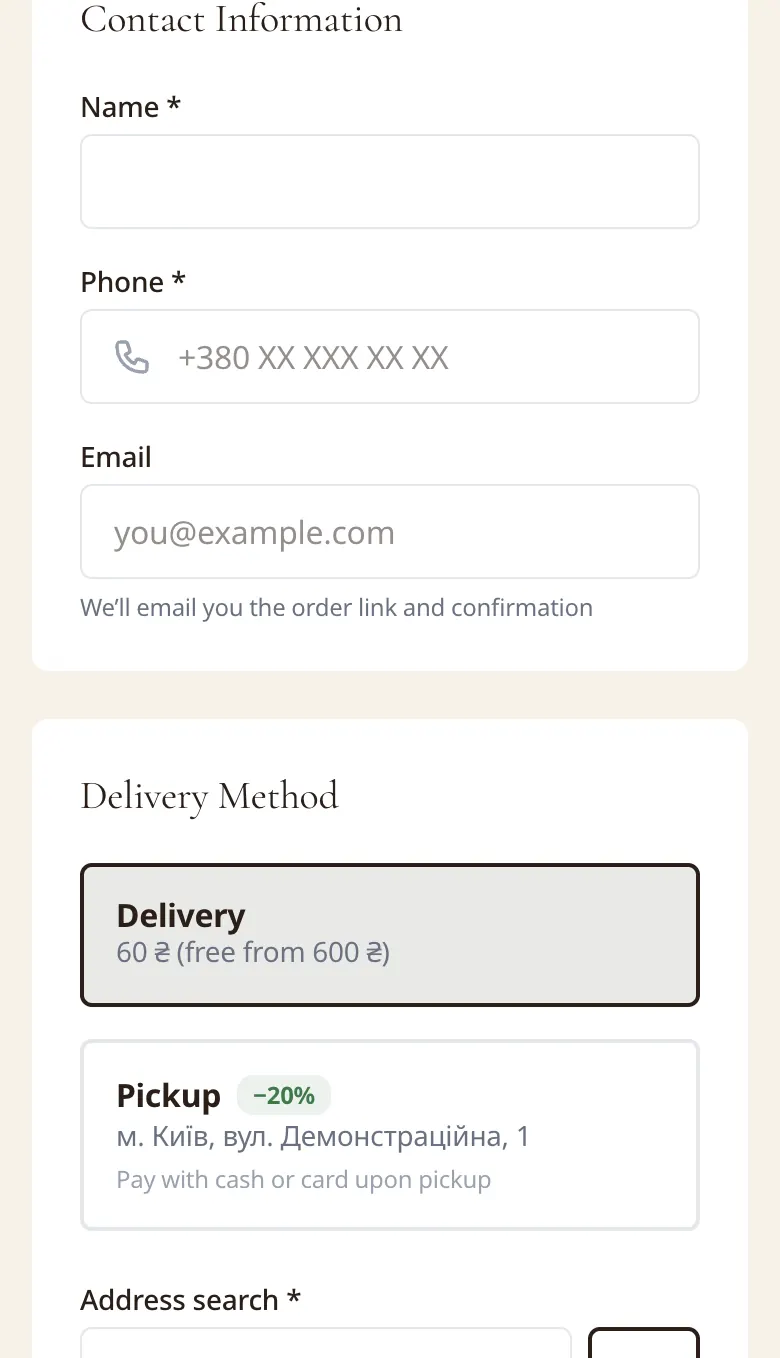
Your own website is a channel where the guest orders from you directly:
- money: online payments go to your account through your own payment provider;
- guests: the phone number, order history and birthday stay with you, so you can bring a guest back with points, a promo code or a reminder;
- rules: you set the delivery zones, the minimum order, pickup and prices yourself.
Your own channel costs money too: the platform subscription, card fees, delivery and advertising for the website. On Vitrina you pay no more than 0.9% (3% with no subscription) of online orders instead of the aggregator’s percentage, and the subscription is in the pricing section.
| What we compare | Aggregator | Your own website |
|---|---|---|
| Who brings the guests | The platform: new guests from its app | You: regulars, QR codes, social media |
| What it costs | A percentage of every order | Subscription and card fees; on Vitrina no more than 0.9% (3% with no subscription) of online orders |
| Whose guest data | The platform’s | Yours: phone, order history, birthday |
| Who sets the rules | The platform | You: zones, minimum order, pickup, prices |
When your own website pays off
Work out three numbers: how much revenue goes through the aggregator each month, what share of those orders comes from regulars, and what delivery would cost you without the aggregator’s couriers. Your own website pays off fastest where there is a lot of pickup and pre-ordering: then there is no delivery to pay for at all.
The commission calculator compares the rate from your contract with a Vitrina subscription and honestly shows what it leaves out.
How to run both channels
A hybrid works best: the aggregator brings new guests, and your own website keeps the regulars.
- 1
The aggregator for new neighbourhoods
Keep the aggregator for new neighbourhoods and people who don’t know you yet.
- 2
A flyer in every bag
Put a flyer with a QR code for your website and a first-order promo code into every aggregator order.
- 3
A reason to order directly
Give regulars a reason to order directly: cashback points, a birthday discount, faster pickup.
- 4
utm tags on every link
Tag your links with utm parameters and see how many orders the flyers, Instagram and QR codes bring in.
In Vitrina, Glovo, Wolt and Bolt Food orders can come into the same system as your website orders once your venue has joined their partner programme.
The bottom line
An aggregator is paid advertising, not a channel for your regulars. Keep both channels, but move the guests who already love you to your own website: with every such order, the percentage stays with you.
Frequently asked questions
Can I work with Glovo and have my own website at the same time?
Yes, and most venues do exactly that: the aggregator brings new guests, the website keeps the regulars. Before you launch, reread your aggregator contract for any terms about prices on other channels.
What does your own ordering website cost on Vitrina?
The subscription depends on the plan: see the pricing section; on online orders you pay no more than 0.9% (3% with no subscription). The commission calculator shows the difference from the aggregator at your rate.
Who delivers the orders from your own website?
Your couriers, a delivery service, or the guest picks up. How it works in Vitrina (delivery zones, the courier app, platform couriers under contract) is on the delivery page.